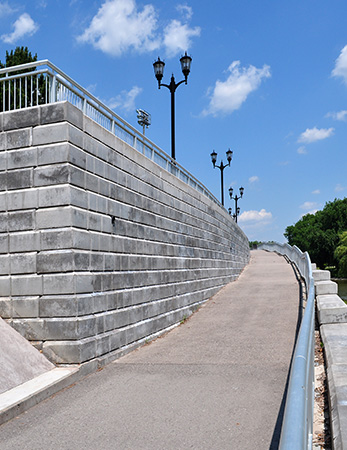
Fort McMurray • SienaStone in the Canadian North

Printable PDF version › RS-CS_FortMcMurray

Fort McMurray SienaStone Case Study

Under budget and on-time, this major SienaStone project in Fort McMurray Alberta is a testament to what is possible when you combine one of the most experienced and knowledgeable Commercial Wall Builders in the Province with one of the most proven Wall Systems on the market.

The Situation

The Canadian North is well known for its harsh, unforgiving winter conditions and rugged landscape. When Commercial Wall Builders Com-Con Paving Stone Ltd. began assessing the logistics and feasibility of installing over 5,500 sq.m (59,000 sq.ft) of Wall in Fort McMurray, Alberta, their 40 years of experience told them that weather, time and manpower restrictions would all be major factors. It was clear that speed of installation was critical, as well as the ability to machine place the Wall System, given the labour shortage in the area at that time. At over 200 kg (450 lbs) per unit (500 Standard), the SienaStone Wall System, manufactured by Expocrete Concrete, fit the bill. The SienaStone System is a machine laid, solid block Wall that can be installed at a rate of up to 100 sq.m (1000 sq.ft) /day with a 3-4 man crew. With machine placement, Contractors know that the rate of installation stays relatively constant all day long as it is not subject to worker fatigue.

The Site

Known as the Eagle Ridge Subdivision development, the Site consisted of a rolling landscape, necessitating substantial retaining walls for functional and aesthetic purposes. The installing Contractor, Com-Con, worked closely with the development Owner, Centron Residential Corporation, and the Site Geotechnical Engineer and Wall Designer, Brad Ellingwood, P.Eng., of E2K Engineering Ltd (www.E2keng.com) to address the many logistic and site issues typical to a project of this magnitude.
Given the residential nature of the development, aesthetics were also an important factor in the Wall product decision. With its linear, chamfered appearance, SienaStone strikes a balance between providing heavy duty performance, with a “non-commercial” aesthetic.
In some areas, the Site Plan design facilitated access to walking paths, an ecological reserve, and residential properties using intermittent in-set Siena Stone stairways, an application the unit height of SienaStone is ideal to handle.

The Details

Over the life of the contract, many changes were made “on the fly” for aesthetic and logistic reasons by the Owner. The scope of work was altered to include placement of loam, gravel and other materials to accommodate the owners’ progressive development, in addition to the installation of the retaining wall. With clear communication between all parties established early on in the Project, Com-Con was able to provide dynamic, flexible solutions to whatever site modifications where necessary.
As this particular site allowed for sufficient space behind the wall for geogrid reinforcement, Walls were designed using the 500 Standard SienaStone Block. This project was completed utilizing a four (4) man crew. Installation sequence and methods were streamlined to produce the walls efficiently and effectively, averaging approximately 600-800 sq.ft per day. Delivery of materials was timed in order to minimize the stockpile areas and ensure steady daily progress.
In the end, Com-Con completed this project 15% under budget, with the result being an amazing example of quality workmanship, heavy duty performance, and great Design.

The Installer

Com-Con was incorporated in May of 1976 as a family business with Reinhard and Werner Moellenbeck. At that time, paving stone installation was rare in Western Canada. The brothers worked with several different companies demonstrating their vast knowledge of paving stones and proper installation techniques. Reinhard collaborated with a local concrete manufacturer to develop their plant to produce paving stones in varying sizes and shapes allowing for more decorative and patterned placement. In 2006, Reinhard’s son Jason joined the company bringing his expertise as a Landscape Architectural Technologist. Jason purchased the company from his father in 2008, and has since propelled Com-Con to be one of Alberta’s premier Commercial Wall Builders. Com-Con has firmly established a reputation of projects completed on-time and on-budget, with impeccable work ethic and installation techniques.

Congratulations to Com-Con on over 40 years in business!


Rivercrest Wall Wins Red Dot Design Award

timthumb

The RIVERCREST® Landscape Wall System has been awarded the “Red Dot Award: Product Design 2013” for high design quality.

The innovative design of Risi Stone Systems and manufacturing quality, impressed the 37-member jury of experts for the “red dot award: product design 2013”. Those who succeed in winning over the renowned experts in the field can decorate their product creation with the “red dot” and position themselves at an international level. The jury members were delighted to receive 4,662 entries in 19 different categories in this year’s competition. Only the best designs were able to win the enthusiasm of the jury, which is how Risi Stone received the Red Dot for its successful design creation.

The Rivercrest® Wall System was awarded for its unique design features, ease of use and ergonomic handling, and versatility. Rivercrest® is designed to look like real, natural stacked Flagstone in the centuries-old tradition of dry-stack retaining walls. The proprietary integrated lateral and vertical interlocking system, which negates the need for pins, clips or other connectors, simplifies construction and makes it easy to design and construct many types of natural-looking vertical elements. Rivercrest® can be used for applications such as retaining walls, planters, two-sided seat walls, tree rings, fire pits, outdoor kitchen structures, water features, and pillars.

Awards Ceremony

The awards ceremony for the seal of quality that is recognized worldwide takes place on July 1, 2013 as part of the traditional red dot gala. The ceremony, held in Essen’s opera house, the impressive Aalto Theater, is always the final highlight of the “red dot award: product design” and over the past years has become established as a celebratory ceremony with international guests. Rivercrest® will then be put on display during a four-week special exhibition in the red dot design museum. With around 2,000 products spread over an area of more than 4,000 square meters, the red dot design museum houses the largest exhibition of contemporary design worldwide. From July 2 to 28, 2013, the museum will host the traditional special exhibition of the award-winning products. In “Design on stage – winners red dot award: product design 2013”, design enthusiasts can marvel at the latest trends at close quarters. Visitors are expressly invited to handle the pieces, allowing them to experience live in the breathtaking atmosphere of the red dot design museum the prize-winning design of Rivercrest®.

Prof. Dr. Peter Zec, initiator and CEO of the red dot, has pointed out that strong design competence and economic success nowadays go hand in hand: “The winners of the ‘red dot award: product design 2013’ are the protagonists of a highly developed design culture and design industry. These days it is becoming more and more difficult to distinguish between well-designed products. It is often only in the details that the special qualities become apparent. However, those product creations that pass the test before the critical eyes of the international red dot jury will not disappear into the crowd and will be able to fend off global competition.”

With the red dot design award, the Design Zentrum Nordrhein Westfalen created one of the most internationally acclaimed competitions. The prize, the “red dot”, has established itself worldwide as one of the most sought-after quality marks for excellent design. The Design Zentrum Nordrhein Westfalen displays the award-winning products in the red dot design museum for at least one year.

West London Dyke

Printable PDF version › RisiStone_CS-London_Dyke


This project is part of a large-scale reconstruction of the existing dyke system along the Thames River in London, Ontario. In this phase,approximately 300m (1000ft ) of the dyke was replaced with a new 8m (26ft ) high DuraHold wall.

Extreme 2 year and 75 year flood events in the Thames River have the potential to completely submerge the entire new wall. Due to the rapid fl owing hydraulic conditions, the DuraHold product was used because its smooth surface reduces drag eff ect from fl owing water. This, combined with DuraHold’s structural stability, high rate-of-installation and the capacity to create curves with its Tapered Half units, made it the ideal choice for this project.

With the river limiting site access, and the necessity to prevent contamination of the Thames River, all construction had to be completed from the high side of the wall. Proper coordination of the excavation, block placement, and infi ll material was crucial because of the limited space. Due to the height of the wall, a fall arrest system was utilized, with anchor wires secured to large blocks. Workers could then harness themselves to the wire allowing the range of movement required to construct the wall.

The complex space constraints and additional factors of the site made excavation and fi lling operations diff icult and consequently reduced the installation rate to approximately 45m2 (484ft 2) per day. Under ideal conditions, machine-placed wall systems can be installed at much higher rates (100–150m2 per day [1076–1614ft 2]). However, because machine-placed walls do not rely on the physical capacity of the workers to place the block, the rate of installation was maintained at the same level throughout the day.

A reinforced toe wall that was constructed to stabilize the original dyke in the 1980’s, was used as erosion protection. It was cut to fit the new wall layout and riprap was placed between it and the DuraHold wall. To allow for the water to exit the infi ll zone as quickly as possible following a fl ood event, the wall was backfilled with a 60cm gap-graded drainage layer. Drainage tiles were installed at grade, and fl ood event elevations, with the drainage tiles outlet through the wall face at 15m intervals.


London-Dyke-CaseStudy2

On the North end, a 90 degree “hidden wall” was incorporated into the layout with a curved section abutting it. This new curved section reduces fl ow turbulence and allows the wall to taper back into the existing dyke structure. The “hidden wall” permits for a future planned expansion and will eliminate the need to dismantle a large portion of the new wall. Simply by removing the curved section and abutting to the “hidden wall”, the wall can quickly and easily be extended.

A pathway running alongside the Thames River was incorporated into the layout atop the new DuraHold wall. The South end of the wall was terraced, allowing the pathway to extend down under the Queens Ave. and Kensington Bridges, and connect to Riverside Park.